

Change is good. Sept. 2015

After 17 years in bucolic Bucks County and 38 years (phew) in Pennsylvania, my husband Jonathan and I are pulling up our roots and heading west. Why? Many reasons. We've bought a home in Santa Fe New Mexico, a small city filled with the vibrations of creativity and art. Plus my husband has roots there. Some of his relatives were early settlers of Santa Fe in the late 1800's. We have a portrait of his great-great grandfather over the mantle in the living room who seemed to always been beckoning us toward the Land of Enchantment. And of course, it's beautiful. High desert meets the sunny, cloud-filled sky and creates drama with the bluest blue and warm light. Yes, we are sad to leave our family and friends on the east coast, but it's time to look to a new horizon. And it's a great place to visit.
But speaking of change- I am so pleased to announce that the James A. Michener Art Museum has acquired not one, but three paintings for their permanent collection. The painting EMISSION from The Idea of Protection series will be on display and we are currently in talks about creating a t-shirt for the Museum in conjunction with KNOW Graffiti Design. They have also purchased one of the large crow painting A MURDER OF CROWS and a large landscape entitled LEAN & GRASP. All three will be included in a new acquisitions exhibit beginning September 23rd.
I will also have five paintings from A Murder of Crows series in a small group show entitled MURDER OF CROWS at The Art Trust Gallery located at 16 West Market Street West Chester PA. For more info on the gallery go to thearttrust.org
This summer has been wildly insane (in a good and exhausting way and I'd like to thank everyone who was there for us and leant a hand (as well as a backhoe - Greg) and all of the people who made art purchases (which was a lot of you) and made my work theirs.
Major museum Purchase
I am very pleased to announce that two of my paintings have been chosen to be included in the WATERCOLOR USA 2015 EXHIBIT at the Springfield Art Museum in Springfield Missouri. AND, my piece was selected as the Springfield Art Museum Purchase Award. I have also been invited to be a member of the Watercolor Honor Society (WHS), one of the most prestigious watercolor organizations in the country and works directly with the Springfield Art museum to promote watercolor nationally with exhibition opportunities. Here's a link to the museum www.sgfmuseum.org
2015 Comes on Strong
The year begins with quite a few shows that I am happy to part of. First- JAM GALLERY located in Malvern Pa. has its winter exhibition and will feature 5 of my pieces. The gallery is located on 321 King St. Malvern Pa 19355. The show runs from Jan. 7 - February 28 and is free and open to the public.
I also will be in a show entitled SWEETHEARTS: CREATIVE COUPLES with my husband sculptor Jonathan Hertzel - jonathanhertzel.com. The show will feature couples who live, eat and work together and influence each other... or not. Here's our statement - "Jonathan and Linda have been working back to back, facing each other, for 30+ years, endlessly motivating one another in their creative, swash buckling adventure." The exhibit runs January 24 - March 8, 2015 with an opening reception on January 24 and artist talk on February 15th at 2pm. The Trenton City Museum at Ellarslie is located in Cadwalder Park in Trenton. www.ellarslie.org
i am also proud to be excepted into The Crow Show, an international juried show produced by The Studio Door of San Diego, California. The exhibition was curated by Jenna S. Jacobs, the curatorial manager of the Museum of Contemporary Art in San Diego. I will be featured on their online version at the website www.TheStudioDoor.com that will go live on February 2nd.
Lastly - for now. Blank Canvas Gallery in New Hope, Pa. has curated a group show entitled CHILDHOOD IN DECLINE opening at 5pm on Saturday February 28th. The show will run thru March and promises to be fun, controversial and provocative. Check out the website - www.blankcanvasnh.com
Coming in September 2014
I am very pleased to announce that I will be featured in the show "Point of View" I will be debuting my "A MURDER OF CROWS" series for the first time. Oils and gouaches will be included.

WHERE ONE ENDS AND THE OTHER BEGINS oil on canvas 36X48"
Here's the info from Perkins Center for the Arts-
A new and exciting exhibition for September 2014 curated by Philip Carroll and Karen Chigounis
features the work of three highly respected artists Linda Guenste , Kay Klotzbach and Barbara Rachko. The exhibition will open September 13 -November 8, 2014 with an opening reception to meet the artists from 6 – 9pm Saturday September 13 at our Collingswood Gallery For more information you can contact us at : http://www.perkinscenter.org
FROM LOST IN THE MEDINA AND THE NEW NORMAL JUNE/JULY 2014
Now that my show is up and running, I thought I should shed some light on what my latest work is about.
I describe my recent work as allegorical, yet it rarely tells a specific story.
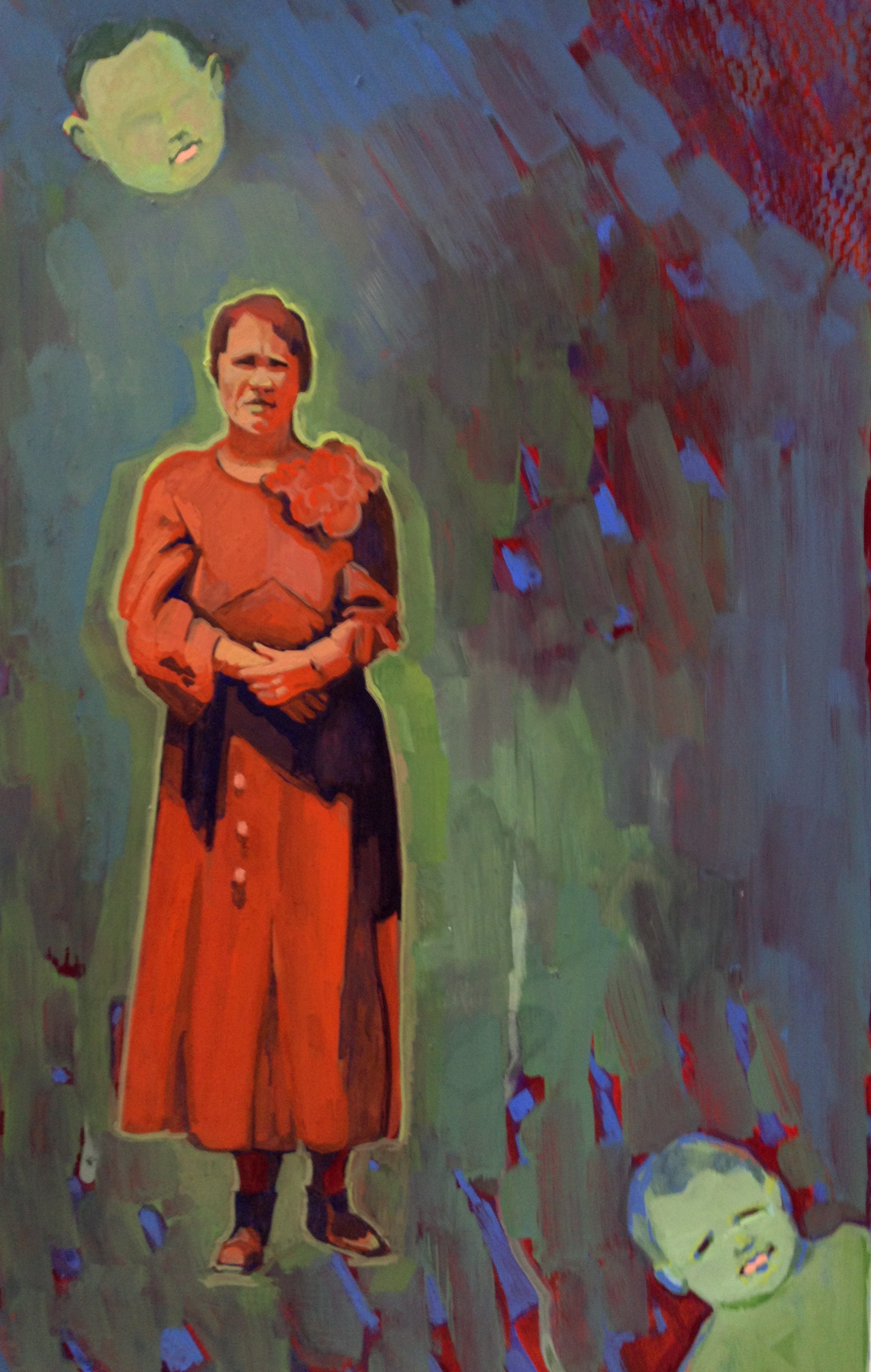
I begin with an image that strikes a cord and my painting evolves from there. The yarn is created by image, color and composition and gets stitched together in a small, intimate piece. Some of the people are plucked directly from family photos, not with the intention of portraying my ancestors, but to put me, the painter, in historical prospective and depict a sense of time and mortality.
I call this body of work LOST IN THE MEDINA. After a recent trip to Morocco, I was both inspired and overwhelmed by the Moroccan art, architecture and culture. While wandering the ancient walled cities of Fes and Marrakech, I realized that my view was limited and obscured and the only way to get from place to place was to make a mental note of the objects I passed like a green door or a crack in a wall. I began focusing on minute details instead of seeing the larger, unavailable picture. Many of us see the world like this today in our computers, on our phones, in front of the television, yet the concept is centuries old. I began to question the contemporary norms and wonder if we’ve changed all that much. Could THE NEW NORMAL be the same, same but different plus electric?
When Dara first suggested titling the show “THE NEW NORMAL” I immediately thought about what it meant to me. Personally. What came to me over and over in my musing is the concept of time. Too much, too little, too long, too short, time travel, time warps, time capsules, time bombs, time lapse, timetables, time frames and timelines. So if I have to describe my recent work in only one word, it would be about time. But please feel free to make up your own stories.
I am so lucky to be with artist Susan Moloney. Her work is unique, carefully detailed, humorous and walks the fine line between reality and fantasy with a touch of creepy (in a good way). And she is a fabulous, nice person. Check out her work at www.susanmoloneyart.com or at the gallery site www.blankcanvasnh.com
Thanks to all that lent a hand for the opeing – Dara & Susan for the encouragement-I am so happy to have gotten to know you both. Eliza for the beauty assist, Ezra for the extra hands. My blood family and my family of friends. And YOU – for coming to the show. And of course Jonathan, for just about every thing else a lucky woman like me could need. Love you.

coming this June 2014
‘The New Normal’
New Hope, PA: Blank Canvas Gallery, located at 19a West Bridge Street, welcomes Bucks County artists Linda Guenste and Susan Moloney for a joint show, “The New Normal” on Saturday June 7 from 5pm to 8pm.
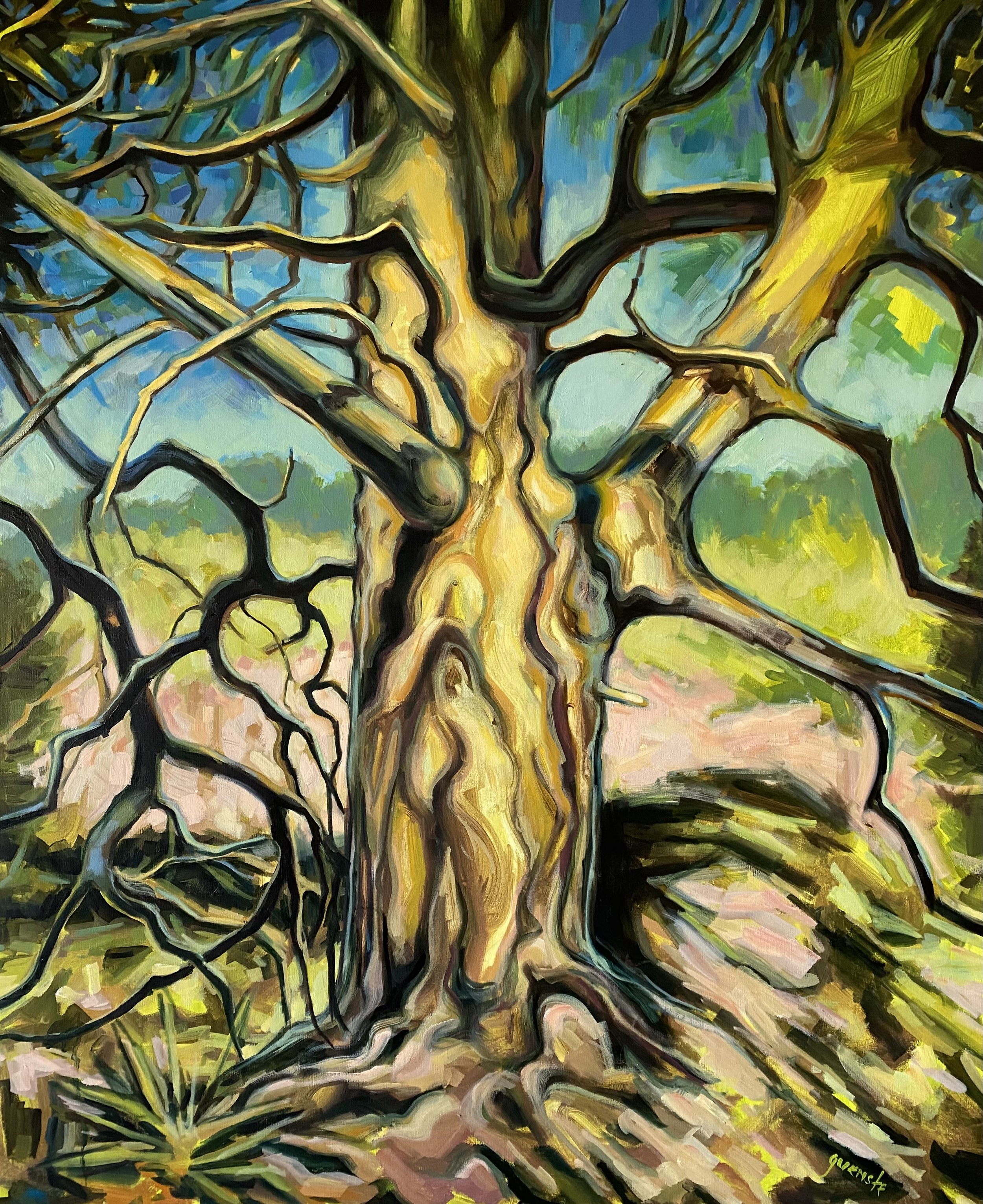
Linda Guenste is an artist best known for her landscapes and intimate portraits of trees, but her latest work has taken a political turn and focused on some of the pressing issues of contemporary culture. An award winning artist, her work has been shown throughout Pennsylvania. Susan Moloney is an assemblage artist, working with mixed media and found objects out of her studio in North Wales. Most recently featured at the New Hope Arts Center, her work echos her fascination with abandoned places and things like doll heads, rusty toys, and medical stuff.
Both artists will be examining the question of ‘What is normal?’ via their works in the show. In our quest for individuality, many personal expressions once thought to be on the fringe of society are now readily accepted. Tatoos, piercings, and the blurring of gender roles is now commonplace in society. Yet we continue to be deluged by the media with images of ‘perfection’ and ‘beauty’. Where within these boundaries does ‘The New Normal’ lie?
The event is free and open to the public, with light refreshments available. “The New Normal” will remain on exhibit until July 19, 2014.
For more information, please contact Dara Zuckernick at blankcanvasnh@gmail.com or find the gallery at www.facebook.com/blankcanvasgallery